You know those promises you make yourself on January 1st each year, only to break them within the next 24hr? Seems like it’s more than pointless to make them. New Year’s resolutions — or broad life goals over any timeframe — might be good, but to me, they only seem a setup for failure.
But what’s life if not a constant learning experience? Through the unexpected and perhaps mundane aspects of life — those same things that keep us all from fulfilling New Year’s resolutions — we’re all growing, learning, changing, and hopefully getting a bit wiser.
2013 was a rather big year for me. It was my first year of married life, complete with all the great things that brings like signing my first home lease and walking through IKEA for days and taking an incredible 2nd honeymoon this winter. It was also the year that I [launched] and [killed a Newsstand magazine], started working on Mutahhir Ali Hayat on [Let.ter] as the first app I’ve had a hand in bringing to market, and worked my 3rd and [final year] as editor at AppStorm. It’s been one of the very happiest, most exciting, and challenging years yet, and I can only wish coming years will prove it to only be a start.
But what have I learned from it? Hopefully a little at least. Here’s the realizations I came to as I pondered this past year over the last few weeks of holidays and vacation:
You’ll Never Know the Full Story, but the Full Story is Out There.
The Snowden revelations about the NSA were honestly not as shocking to me as perhaps they should have been, since somehow it almost seems self-apparent that people — both nefarious and “good” (hi, Google) — are recording every page online, every place we willfully checkin, every photo and update we publicly share, and so much more. Perhaps reading [Rise to Globalism: American Foreign Policy Since 1938] in college and more recently [Dirty Wars: The World Is A Battlefield] made me assume, despite my horror, that there’s so much more going on behind the scenes than many want to think.
And then, I read the surprisingly interesting new book Hatching Twitter on my holiday break. It revealed no nefarious use of private data — indeed, it focused rather on Twitter’s efforts to protect users’ privacy from government agents, despite the fact that Twitter is the most public of all social networks which makes such privacy vanishingly helpful. What it did reveal, though, was the inside struggles of the founders of the social network that’s changed the way we all look at the world, 140 characters at a time. Jack, Ev, Biz, and Noah’s stories and paths to building Twitter came to life in a way that, thanks to media appearances, one could assume was only about Jack, the guy who also made Square.
Perhaps it’s not so surprising the government has hidden power struggles that we can only hope aren’t as brutal as House of Cards portrays, when the startups that are the bread and butter of our industry — and that convinced the rest of us to share everything about our lives in public — have their own private dramas that manage to stay out of the public eye. And yet, all the data’s still there for the taking if only one will put it together and find out the full story. That’s why I can’t find the NSA so shocking, even while I’m still revolted that they’re possibly monitoring this post as it’s written and synced to Dropbox even before I’ve put it in public.
We all didn’t put the Twitter story together even though bits and pieces of it were out there. But you can bet someone did. That potential to piece together “hidden” stuff from bits and pieces of semi-public data is why I can’t imagine the NSA will truly ever cease to exist — and why, on the other hand, we should almost assume there’s other governments and private companies and basement hackers collaborating very similar data sets for myriad reasons, good and bad.
And yet, even still, the next time you hear the news or read a company blog post, go ahead and assume you don’t know the full story. You quite possibly might be able to piece together a fuller picture from any number of data you could piece together, but you can almost guarantee a single report on a revolution or war or company pivot is really the full story.
Profit is Far More Challenging than Just a Great Idea
After starting and subsequently shutting down a magazine project of my own, and then having my employer shut down the site I’ve worked at for three years, it’d seem that this is the lesson most obvious to me from 2013. It’s easy to come by an idea these days, and even easier to launch the first vestiges of a business and product on the internet. It’s far, far harder to turn those ideas and ventures into profitable businesses.
And it makes me fear for the many, many brilliant, tiny apps out there — some can turn into a tiny business, sure, even one that’s moderately profitable, but paying back millions of venture money? Somehow I can’t imagine every startup we know and love will ever be able to.
Forums are Amazing. And Awful.
There’s a black-and-white picture that’s circulated the ‘net the past couple of months of men with their faces covered with a newspaper on a train in the late 1800’s. It’s typically used to poke fun at the idea that smartphones have made us less social. Point proven.
And yet, all is not well. Perhaps the newspapers those guys were reading were filled with yellow journalism and tabloidic headlines. And the stuff that fills the screens of our devices so often is of equally low or lesser value. That’s especially true when you spend any amount of time on forums, such as Reddit and the more sophisticated Hacker News.
I’ve read plenty of great, thought provoking and helpful article and full books this year, once that reminded me all over again why I love reading so much. And yet, for every one of those, I’ve also read through dozens of NSA rants and comments about startups and hilarious discussions about cat pictures and insane Buzzfeed (or, gasp, Business Insider) photo roundups. I’ve gained some from reading Hacker News (Reddit, not so much), but it still is an addictive time waster.
So here’s a realization that’s turning into a resolution: I want to read more quality posts and especially full books this year, and purpose to skip the junk food diet of the internet. And if I need a bit of diversion or entertainment, I’d rather follow Rands advice and [build stuff]. Because I agree: the feeling of making something is far, far better than the bloated-junk-food feeling of reading comment replies for an hour.
People are Awesome.
Regardless of how cynical the news may make you, people are still amazing. They’ll hurt you and frustrate you, sure, but they’ll also amaze you and make your life better. For every person out there that hurts you, there’s plenty more ready to help you get back out there and be stronger than before. For everyone that uses you, there’s tons more that are ready to do stuff for you for no good reason, things that’ll make you humble and wanting to go make the world a better place yourself all over again. And the more time you spend with people — and away from screens — the better. Which is why I should close this piece.
*****
So there, some major takeaways from 2013. Now, onwards and forwards to learning what 2014’s here to teach me.
Just over 3 years ago, in late October 2010, I filled out a writer application on iPhone.AppStorm in a bit to start writing about iOS after I’d gotten my first iOS device — a 2nd hand 3rd gen iPod Touch. Josh Johnson, the then-editor, graciously replied, and weeks later my first AppStorm post (oddly enough, about the Bing for iOS app that I can’t remember using once since writing the post) was published. And with that, my AppStorm journey began, one that’d lead me to becoming editor of Web.AppStorm 6 months later and finally going full-time with AppStorm when I additionally became editor of Mac.AppStorm just over a year after that.
Along the way, I managed to write for every AppStorm site other than Android.AppStorm, penning a total of 771 articles (not including sponsorship posts), which averages to very nearly one full-length article per week-day since I first wrote for AppStorm. Most of my articles were around a thousand words long, so I’ve easily published well over 700,000 words for AppStorm (and quite possibly over a million). Far more importantly, I’ve made great friends on the AppStorm team, virtual met dozens of amazing developers, paid off my college loans and gotten married. It’s been one awesome journey.
But sadly, the AppStorm phase of that journey ends here. Collis, Envato’s CEO, penned the last AppStorm post today announcing the site’s closure, something I’ve known was coming now for a short while. It’s a bittersweet moment — we all wished AppStorm could be more, and want it to live on, and yet I’m excited about my future at Envato where I’ll now be working as the new Software Training Editor at Tuts+. And the AppStorm legacy will live on in all of us, as each of us who used to be on the AppStorm team will continue to write about software on our own — expect to see more app reviews on Techinch in the coming weeks and months.
AppStorm all along stood for high-quality independent software reviews that, in the period when the word “app” entered the common vernacular, made it easy for anyone to see if a new app was what they needed in their toolkit. I’m tremendously proud of the work our team did, and will always be proud to say I was the Mac and Web editor at AppStorm. And yet, it was still tough. Writing full-length, high quality, exhaustive reviews is still hard work, and paying for it with banner ads is tougher since every site is competing for quality sponsors and pageviews. Still, I believe the AppStorm team did a great job despite the odds.
That's why it only makes sense to say thank you to the AppStorm editors who took a chance on me when I first started: Josh Johnson, David Appleyard, and Jarel Remick. And then, thank you so much to each of my co-editors and managers at AppStorm: James Cull, Kevin Whipps, Rita El Khoury, Joel Falconer, and Joel Bankhead. Last but not least, thank you to each of the awesome writers I've been privilaged to work with at AppStorm. You guys are awesome, and I'm honored to have worked with each of you.
So now, I’m starting on my new Tuts+ position, one you’ll hear more about soon — and I’m also working on some Techinch.com tweaks that’ll make it better for high quality app reviews. It should be an exciting year!
Several years ago when the 37signals team released their book Rework, I was struck by the beautiful hand-sketched illustrations almost as much as the content of the book itself, and then was delighted to see the same illustrations beautifully translated for the Thai edition of Rework. That beauty was thanks to the work of Mike Rhode, who's since turned his skills into a book — The Sketchnote Handbook. It's got the same charm as his pen-drawn illustrations, and yet he had a secret weapon in making the book — he'd turned his sketchnote writing style into a typeface.
That typeface is, appropriately, the Sketchnote Typeface. It's got the charm of handwritten text with extra whimsy you'd expect from a sketchnote, while being a font you can use in your own work. And from now until New Years, you can get 20% the Sketchnote Typeface with the coupon code TSHBG. That'll get you the Sketchnote Square + Dingbats font — the combination used above — for $23, or the whole typeface of 4 weights for $79 for now until New Years.
Sure, it's not a font you'll want to do all of your work in — that font, for me, is the incredible monospaced font Pitch from Klim Type Foundry — but it is a font you can have a lot of fun with. Sketchnote is that writing font you can use, for once, without getting made fun of. Comic Sans, you've been outclassed big time, this time.
A review of the app that makes sure I write reviews
OmniFocus is a fabled name in Mac geek circles, made by an equally legendary team of developers at The Omni Group. It’s fabled for good reason: it’s powerful.
Based on the outlining app OmniOutliner, OmniFocus on the Mac feels almost more like a spreadsheet or plain-text app than most polished to-do list apps, and that’s a huge benefit. With its Projects, Contexts, and start and due dates, you can view everything in your entire task database at once, or drill down to just see what’s most important for your work at hand. You can even arrange projects in the order stuff needs done, so (say) you won’t see a task to backup your Mac until you’ve completed the “buy an external HDD” task. That, in a nutshell, is what I love about OmniFocus. It’s powerful, and works great.
But, it has never has sported the most polished UI on the market (that award would have to fall to Things or Wunderlist). If anything, the first OmniFocus for iPhone was the ugliest of the trio of apps. It looked essentially like a stock list app in iOS, with the power of OmniFocus’ features underneath. The iPad app was the one with the polished, custom-designed UI that made it the version of OmniFocus of choice for many of us, but the iPhone app felt fully utilitarian, perhaps on the level of the Mac app. It’d keep you organized, and you’d come to fully rely on it more than you possibly could any other task app, but it sure wasn’t the app to go to for UI design inspiration.
That is, until OmniFocus 2 for iPhone was released. The new version immediately looks at home on iOS 7, but is also obviously not a stock app. The Omni team took the default UI style in iOS 7, and made it their own while bringing every single OmniFocus feature to the computer in your pocket. The main place you’ll spend your days is the Forecast view, which first came from the iPad app and now is equally powerful on the iPhone. The lite UI lets you easily see all of your data in an uncluttered interface, with little enhancements like Save+ to quickly enter tasks one after the other that make it more powerful than ever. The new design is nice enough that it’s easily the nicest app in the OmniFocus suite while staying as powerful as its counterparts on the Mac and iPad. And, best of all, it still works great with apps like Drafts and Siri Reminders to easily send tasks to OmniFocus on the go.
Much ado has been made over the price of the new version, but I see nothing at all to complain about. We get the Omni Sync Server for free if you choose to use it, and the Omni Group’s great support and generous 30 day return policy that no one else offers on the App Store. That and, of course, the most powerful task app with a beautiful iOS 7 design — that’s got to be worth something. I was more than glad to pay for the upgrade this time, and if in 3-4 more years they see fit to make another equally exciting upgrade for that price, I’ll be glad to pay again.
But you know what’s great? OmniFocus for iPhone v.1 still works great on iOS 7, and their team just issued an update to quash the few bugs it had on the new OS. So, if you own the older version and don’t want to shell out, you still can use the old version just like you can still use Photoshop CS5 on your Mac. Just don’t watch the OmniFocus 2 demo video, or you’ll end up wanting to open your wallet.
Next up: OmniFocus 2 for Mac. I can’t wait to see what it brings — and if it’ll finally be the leading app that the other two versions need to catch up to. But I’m fine waiting — OmniFocus 1 for Mac is still working fine, as is the current v.2 beta, and v.2 for iPhone has me more happy than ever with my taskmaster of choice.
Email's the original and — in many ways — best way to privately communicate with anyone online. It just works, no matter what email service your friends use, something you can't say for social networks. There's no way to Twitter DM your Facebook friends, but email works whether you're using Gmail or Yahoo! or Exchange or your own SMTP server. For all the talk of replacing email, it's really still good, and there's no reason to get rid of it.
But that doesn't mean it isn't a mess, because it is. Inboxes need cleaned, junk emails need deleted, and the constant dings and notifications are only slightly better than Aol.'s old "You've got mail!" alerts. It's distracting. If all you want to do is write an email to a colleague, opening your email app is asking to get distracted by all the inbox chores you need to do. Plus, most email apps aren't really focused on writing — they feel more like a text box form online with small text and dated formatting options.
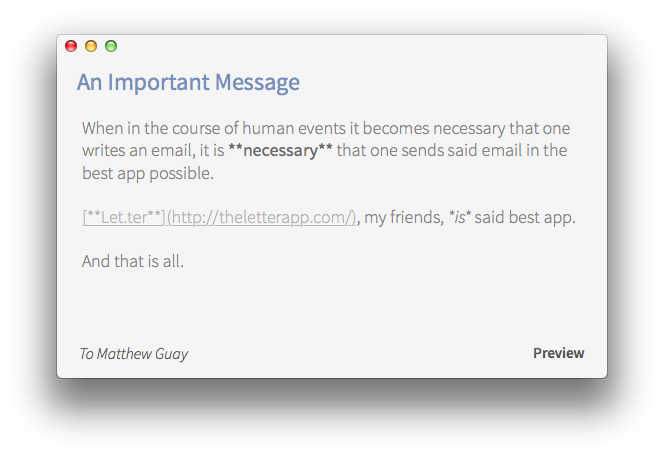
That's why I so often switch over to my favorite writing apps to compose an email with Markdown and no distractions, then copy the formatted message to my email app and send.
And yet, there should be something better, and soon there will be. I've been working with Mutahhir Ali Hayat, a developer that's worked with HogBay Software on FoldingText and more, on a brand new app to make writing emails as nice as writing in your favorite writing app. The app is Let.ter, and it's coming to an App Store near you very soon.
Let.ter's a clean writing slate for your emails that lets you just focus on what you're saying, then send a formatted email directly from the app without having to open your full email program and get bugged by your inbox notifications. It's lightweight, simple, and we happen to think it's beautiful.
It's not ready just yet, but I'm pretty excited about it. If you love minimalistic apps, I think you'll like Let.ter. Be sure to signup for our email updates at theletterapp.com to be the first to hear when it launches, and I'll have more to share soon about Let.ter and the work we've put into it.
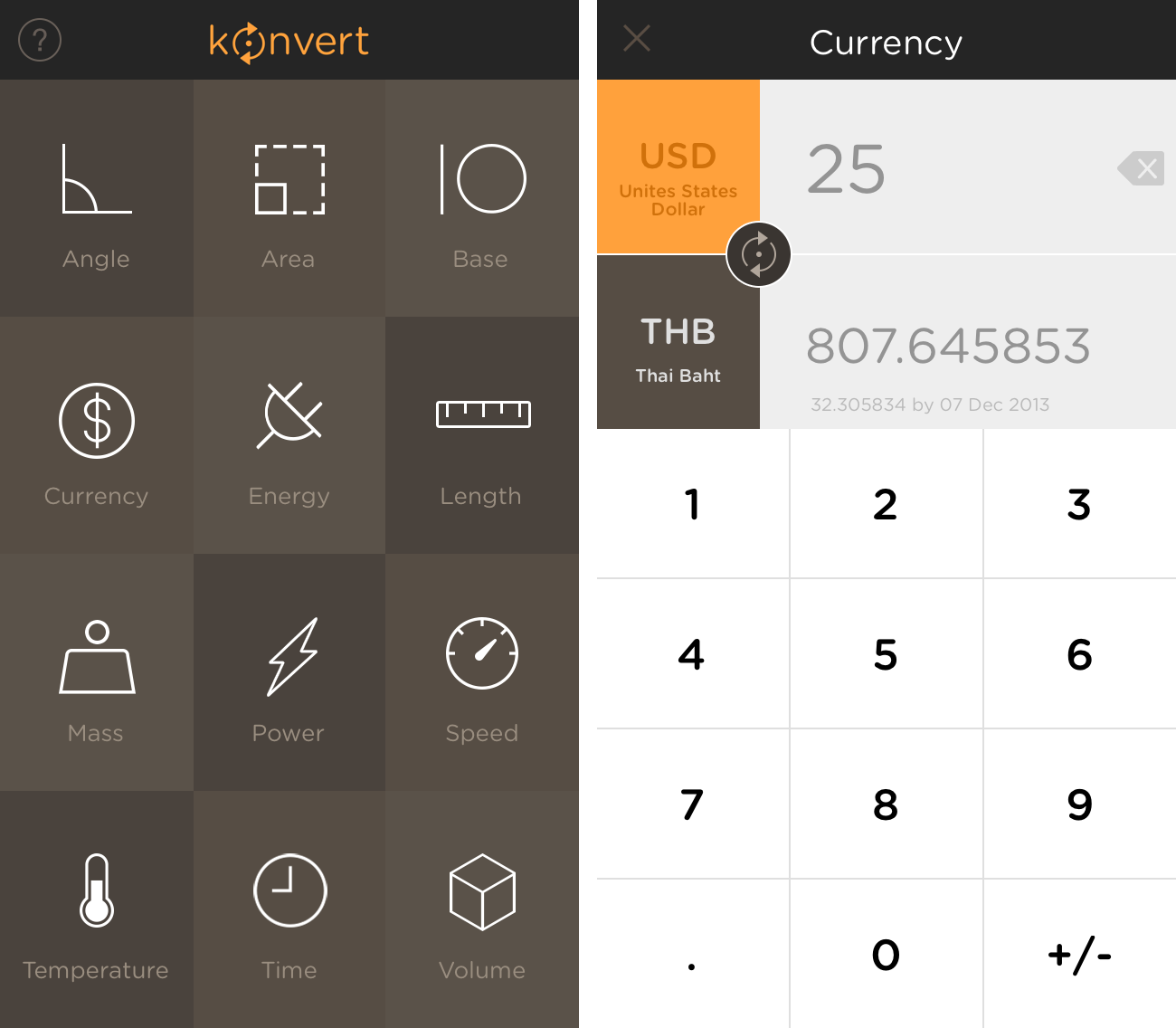
Several months ago, I stumbled upon a converter app that quickly became my favorite way to convert measurements and more: Konvert. It had a simple, flat UI that almost is more reminiscent of Windows 8's UI than of iOS 7, with the different conversions listed in tiles that flip to reveal the conversion screen when you tap them. It's simple, easy, and works great, and so even though it'd already been out for several months, it easily hit my list of favorite new iOS 7 apps when iOS 7 was released, since its UI fits in so well. And since then, the InnovationBox team has continued to improve it, adding currency conversion (including Thai Baht, yay!) and more that's kept it one of those essential little utility apps on my iPhone.
So when their team recently released the new Kounter, a simple counter app, I knew I had to try it. Kounter makes it as simple as possible to count anything — think of those little push-button counters that security guards use to make sure everyone leaves the building, but redesigned with iOS 7's thin font design, and that's basically what it is. I was disappointed that you can't just tap the main circle to count, but instead have to tap the plus on the bottom, which makes it a tad less fool-proof for quick counting when you're not looking at your screen. But still, it's a nice new approach to a simple app concept.
Then, their team also has made Calcolor, a beautifully simple calculator app that matches your iPhone 5c or 5s color and case accent color — and happens to look great on any other phone, even if it doesn't look quite as cool. And, the demo sites for each of their apps are equally fun — they show off a full demo of the app in action, in a way that makes sense on the web.
If you need simple number apps for your iPhone, go try these out. I can't wait to see what their team puts out next!
Computing in public isn’t odd. So why are laptops suddenly odd?
If you live in a dense metropolitan area, public transit is a way of life. Subways and other trains, busses and taxis, and some rarer transportation life forms like Ducktours in Singapore and Tuk-Tuks in Bangkok all serve to get us huddling masses from point a to point b without much thought on our part. And hey, while you’re en route, why not get a bit of work done?
Before the turn of the century, computing on the go was a luxury reserved mostly for politicians and businessmen in power suits. Blackberries, at first, helped smartphones keep that same cachet, but Apple’s iBook (the laptop, not the app and bookstore) and cheap HP and Dell laptops had long-since become common among the rest of us. It’d almost have been odder to sit in an airport lounge without a laptop than with one, and pulling one out on the train — provided there was ample seating and no one needed your chair — wouldn’t have been an odd sight.
That wasn’t long to change, though. Once smartphones and modern tablets burst onto the scene, laptops started being the new desktop and looked rather odd on the train. It’s normal to peck at your touchscreen while standing in a crowded train, but typing on a 13” laptop? How quaint.
Just a few months ago, I was riding the Bangkok BTS mid-morning, with plenty of empty seats around me. I was going to be en route for a half hour, so why not get some work done on my MacBook Air?
So I started writing, and got about 15 minutes worth of stuff done while riding. And nothing happened — except for the fact that everyone on the train looked at me like they were seeing a ghost.
Of course, everyone else on said train was looking at their own computers — only theirs were 4 inch phone screens, or 7 inch tablets (yes, even the full-sized iPad is starting to look large in public, at the same time the iPhone is looking too small compared to Galaxy Notes. It’s a strange world). Surely a 13” screen isn’t so odd. But it was.
And yet, what’s actually odd is that everyone was using laptops in public just a few years back. That’s actually odd, if you really think about what most people were doing. They were carrying around a full computer just to browse Facebook on public Wifi, or at best answer some emails and browse the web. There’s always people actually getting real work done on laptops on trains and waiting rooms, but that’s not the majority.
So now, we’ve got devices that actually make more sense for on-the-go computing. It’s not so much that smartphones made online chat possible, it’s that they made it practical anywhere. eReaders and tablets didn’t invent eBooks — I’ve read full books on a BlackBerry-style Windows Phone in the past, of all things, and of course have read many on Macs and PCs — but they made them practical. Google Maps was always something nice on the PC, as Mapquest was before that, but smartphones and tablets made them practical in ways they’d never have been before. In the same way VisiCalc made PCs make sense for business customers, Google Maps and WhatsApp and Facebook made smartphones make sense for everyone.
There’s still spreadsheets and AutoCad, app development and video editing, and so much more that makes more sense on a laptop. Those are the PC and Mac killer apps — the very reason we buy them. And if you really need them, it’s worth lugging around a laptop.
But that comes with a problem. See, no matter how light and thin laptops become, they’re still large machines. They block your vision, take up a rather significant of lap or airplane tray space, and make you look like you’re in a displaced cubical. Tablets and smartphones, for all their faults, make you look more available, more social — even if you’re really being a zombie behind your tiny screen. You’re not the guy taking up a seat on the train anymore, you’re just someone else holding a tiny piece of aluminum and glass when you’re using your smartphone. But a laptop? Go back to the office, dinosaur.
And yet, that doesn’t quite make sense, either. The very idea of laptops is to be able to work from anywhere, and that’s good. It’s just that most people don’t need full computing anymore for the work they’d do on the go.
And somehow, for the very same reason, I don’t happen to think laptops — PCs and Macs in general, at that — are going away anytime soon. Smartphones are better at some things, tablets at others, and PCs still have their place. As do servers, and to a degree mainframes. It’s just like Steve Jobs said: PCs are trucks, and everyone doesn’t need a truck.
In fact, if you’re still driving a truck, everyone in the city might look at you like you’re a freak on the highway. But you’re getting the work you need done, and their tiny compact gets their work done. Neither is right, neither is wrong.
There’s a bitter gourd — ma’ra in Thai, Momordica charantia in Latin apparently — that’s rather popular in Asia in soup and a handful of other dishes. You can stir fry the leaves (not bitter), cook the young gourds with eggs or veggies (again, not bitter), or you can wait until it’s full sized and boil it with pork ribs to make soup. The latter is terribly, insanely bitter — or at least so I thought, the first time I tried it when I was 11 or so. I remembered the name just to avoid it.
And, sure, as fate would have it, I’d tried it several times through the years. Same as always, it was bitter. Edible, but bitter enough that I couldn’t imagine why people actually paid for the stuff. But there’s plenty of other great things to eat, so why force yourself to eat it if it’s that horrible, right?
Except it wasn’t horrible. At least not now. I don’t know what happened, but several years ago my now-wife got me to try it again at her parents’ house. So I tried it. You’re not going to refuse food the people you hope will be your inlaws just cooked for you, of course, so I planned to act like I like it.
And then I did like it. Just like Sam-I-Am, that green food wasn’t nearly as bad as I’d thought. In fact, it was so good, I got hooked. It’s somehow gone from the thing that I wondered why it was always on the menu at good restaurants to the comfort food I want when I’m tired and away from home. Life’s strange like that.
Apparently it’s something with long vegetables, because the only food I ever really hated as a young kid was eggplant. Mom had made Parmigiana, and 4 year old me could only think of how terrible it sounded to eat a plant made of eggs. And so, I proceeded to gag through dinner. I was quite the pleasant kid.
Of course, today, take me to an Italian restaurant and order Parmigiana, and I’d be as excited as if you ordered anything else on the menu.
Tastes change.
It’s become a running joke at our house that whenever my wife suggest to try something that I say I don’t like, I’ll end up liking it. And more than often it’s true. Those things I hated as a kid, I’ll love now. The foods I thought were horrible even a couple years ago just might be the thing I love today.
The opposite goes, too. I used to love flavored green teas, until I started drinking premium fresh green tea with nothing else added. Just tea. And I fell in love with it. Now, flavored bottled teas taste like syrup — they’re decent with ice on a hot day, but no match for real green tea.
See, with so many things in life, there isn’t a wrong and right. There’s some things you’ll like more than others, today, but a preference does not a law make. Chances are, you just might like something tomorrow you hated today.
In technology, we’re as prone as anyone to just rooting for our team. I’m not a football guy — at Thanksgiving, I had to admit that I literally only knew the team names and nothing else about Football. For me, Apple and Microsoft, Canonical and Mozilla, Google and Automattic, Realmac and The Soulmen and the dozens of other awesome indie developers — they’re my teams. I root for Apple, mock Android, and immediately assume a new app is awesome if it’s clean and supports Markdown, and horrible if it has a toolbar of buttons and relies on rich text. And I’m not uncommon: it’s the most common thing on the internet.
Perhaps it’s just part of human nature: we pick the things we like, and then pick on the other side just because it’s not “our side”. We’re as bad as kids fighting over which action figure is stronger, only we sound more sophisticated. But we pick our sides so strongly, we can’t come down. You either love the terminal and hate graphics, or can’t imagine ever touching the terminal. You either think touch screens are the end all and be all of technology interaction, or you are so dedicated to keyboard shortcuts you can’t see the point in having mice, let alone touchpads or touch screens.
And yet, there’s good and bad in both iOS and Android. Windows 8, even, isn’t all bad. Markdown is awesome, and focused apps are a godsend, but rich text isn’t evil and toolbars have their place and purpose.
And bitter gourd isn’t so bitter after all.
It’s silly to assume you’ll dislike something just because. So try stuff. You might like it, you might not. Either way, it’ll make you a bit wiser, a bit more open minded, a bit more willing to see why others might not like your favorite thing, too.
It’s a big, interesting, exciting world. You’d be missing out on a lot if you always assumed you’d hate everything.
An idea from late last year turned into a year long side project that cumulated with a Newsstand app in the App Store, my first revenue payment from Apple, and those tell-all numbers that made it obvious a paid magazine wasn't the best next step for a blog with 10k pageviews most months. There's hopefully something others can learn from the numbers and effort and App Store gottchas I already wrote about, but what's really the takeaway from launching a paid magazine? I mentioned to a friend that it was a learning experience (as is all of life, of course), but then, what did I really learn from the magazine?
So here's a few takeaways from the magazine app project, stuff I've learned that maybe will be a help to you too:
1. Writing is hard.
That should be obvious to me, since I write for a living at AppStorm and elsewhere. And yet, writing Techinch Magazine seemed a much harder task than I would have ever imagined. I'll write over 10k words any given week, easily, but writing an extra 4k each 2 weeks for Techinch Magazine felt painfully difficult.
Here's really what made it harder: I wanted to do it good. People were paying me to read my writing — not just spending time on my site for free and perhaps clicking ads, but paying real cash money. And I had to make something they'd love. That felt far more daunting than pushing out a blog post.
And so, as I'm apt to do with daunting projects, I'd delay and procrastinate and wait until the last second. Instead of writing a half hour a day for the magazine as I should, I'd wait until the Friday it was supposed to be released and then plow through hours of writing and editing. It feels good to get it out after that, but man, there's got to be a better way.
If you're going to try something like this, just seriously keep writing every day. Really. I should have. Also, you've got to somehow keep yourself from worrying about what people are going to think. Worst case, they'll cancel their subscription. They won't kill you. And hey, they just might like what you wrote when you weren't caring so much about making it worth their money.
2. Doing more of the same thing is harder.
Of course, maybe my real problem was that I was already writing reviews and op-eds and tutorials for my day job, and there's simply a limit to how much one can write. That's very true, too. Perhaps one should pick hobbies in different areas than their day job — that sounds like a good idea. But then, writing about technology is what I love.
But then, web publishing has daily deadlines, and my magazine had a bi-weekly deadline. It was all too much the same — and too much raw content for one guy to put out. That's enough to burn you out from both your day job and your side project, and that's bad.
So I intend to keep writing, obviously — here, at Envato's sites, and otherwise. But I've also got a new project — yes, writing again, but in a different way — working on the marketing side of the new Let.ter app. And I'm planning to work on a book still. But what I don't think I can do is to do more of the exact same thing I do at my day job every single day. At the very least, for Techinch.com stuff, it's got to have a different tone or focus or something that differentiates it. I did that with Techinch Magazine, too, but the shear volume required made it feel too demanding.
3. Splitting your focus is bad
But then, I actually already had a split on what I wrote about at AppStorm and Techinch.com. I'd review apps in-depth and write more core tech articles there, but on Techinch.com I'd write simpler reviews and pointers about tiny tips I come across, and then wax poetic about the place tech fits into our life and similar lifestyle-focused pieces. That worked, and I figured that latter would be the best fit for Techinch Magazine.
And yet, now my focus was split. When I came across something new and interesting, or had a thought for an article, I'd wonder: do I write about it on Techinch.com, or save it for a Techinch Magazine article? I'd typically opt for the latter since I always needed new content for it, but then it'd go on my to-do list in OmniFocus and end up not sounding as interesting by the time I got around to writing it. The split focus made me fail both my blog and magazine.
4. Paywalls are awesome and terrible
Paywalls are the name of the game for newspapers and magazines and increasingly blogs these days. They make sense: you charge people to read your stuff, and suddenly you're not worrying about filling your ad slots and wishing your users would quit saving stuff to Instapaper or using Adblock. And they work good for some publications.
But they also restrict you. Online paywalls that are semi-porous work better (see the NY Times with their fairly generous paywall), as people can still easily share your articles and save them and such. If you're publishing in a paid app, though, your articles will be seen by the handful of people who pay to read your writing, and that's it. If you get enough subscribers to keep the lights on, great, but it's not going to raise your writing profile at all. That's very frustrating when you're accustomed to the instant feedback the internet provides.
5. Technology is amazing
It's incredible that you can launch a business from a laptop anywhere on earth these days and have people paying you money for your products without ever seeing each other or running a real store or anything. Sure, that's nothing new, but it's still amazing. With a handful of cheap apps — or, honestly, a ton of free tools that offer more than enough to get by — you can make something that'd rival the early digital offerings of any publication, and then sell it easily with the App Store and simple online stores like Gumroad. That's amazing, and we shouldn't lose the wonder of that. We take tech for granted so easily, but really, that's still magical.
6. People are more amazing
For all the complaints you'll hear from developers and publishers and more about fussy, entitled customers, there's dozens more out there who are genuinely awesome, who pay for your products and let you know they love it, and who spread the word for you just because. People are awesome.
There's always the vocal complainers, but something at AppStorm recently taught me an interesting lesson. We've noticed that comments tend to be the opposite of our articles. If we complain about an app (say, the new iWork for Mac apps), people who actually like the changes will comment and tell us how we're wrong. And if we happen to be the ones who like the app, and others hate it, you'll be sure to see the comments filled with people who thought we were crazy for our opinion. The iWork reviews on AppStorm were a great example of that, but so was another recent article: a news post about MailMate crowd-funding its 2nd version. The article got comments from people saying the app was overpriced and such, but then, thanks to IndieGoGo's statistics, I was able to see that AppStorm readers — apparently the amazing normal people who didn't comment — contributed hundreds of dollars to the same project.
Most people are really, really awesome — they're just quite about being awesome. Just ignore the loud haters, and you'll be fine.
*****
So there, a few takeaways from what I've learned with the magazine. Now, to the next ventures — and more writing right here at Techinch.com, my original writing home on the internet :)
Steve Jobs famously quipped that people don’t read anymore, but then launched two apps that seemed the savior of independent publishers: iBooks and Newsstand. iBooks, pared with iBooks Author, is an exciting shot at reinventing how eBooks should work. And Newsstand, with simple subscriptions, automatic issue downloads, and beautiful cover icons, seemed the best shot to turn a blog or a print magazine into a digital paid magazine.
Marco Arment’s The Magazine, launched just over a year ago, was the first smash indie success on Newsstand. It made Newsstand make sense, and inspired many of us to try to publish on Newsstand ourselves. When tools like TypeEngine came along, Newsstand seemed the obvious place to move your writing behind a paywall.
The Gamble.
So Techinch Magazine. I’d wanted to try out making a digital magazine, and when TypeEngine announced they were making custom Newsstand apps and a publishing system, I signed up and was accepted as a launch partner. That gave me a free magazine design, and waived my $25/month publisher fee for the first 6 months, leaving me with just a $99 Apple developer account and a $0.15/issue/download fee. I’d price the magazine at $1.99/month, and publish twice a month. After Apple’s 30% cut, and perhaps 3 downloads per user per issue, I’d take home $0.80 per subscriber.
It sounded like it’d work out great, at least if you didn’t think too hard. $1.99 per subscriber sounds like a decent amount, but $0.80 is far less exciting — but it’s hard to keep the first number from clouding your vision.
To make the magazine break even (aside from the cost of content and time), I’d need to have at least 10 subscribers each month to pay for my $99 developer fee, and once I was past my 6 month grace period, I’d need another 31 subscribers to pay for the TypeEngine subscription fee. That means I’d need a total of 41 subscribers just to make $0, and that’s assuming no one downloads the magazine more than twice per issue. Just one extra time per user would mess everything up.
The Reality.
So, ready to turn an idea into reality, I got the content ready for the first issue of Techinch Magazine, worked with the TypeEngine team to turn Techinch.com’s theme into a magazine app theme, and hit the App Store a few days ahead of the July 1st launch. Initial downloads were very exciting to see — being listed on the new apps lists and showing up on the first page of the Newsstand section of the App Store was worth a ton of downloads, even without being featured. What it didn’t turn into, though, was subscribers.
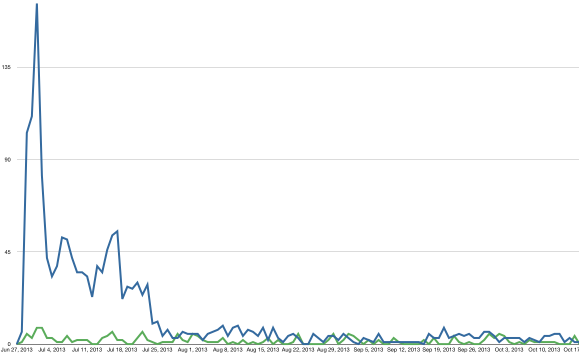
On the chart above, you’ll see the great download numbers (at least compared to the eventual low numbers) in the first 3 days, with over 100 downloads each day. Then, it leveled off to around 30 downloads per day for most of July, and finally trickled down to mid single digits. Interestingly enough, with next to no promotion aside from my blog, the app still got at least several downloads almost every day. All together, Techinch Magazine app has been downloaded over 1,600 times.
But subscribers are the make or break number, and they never broke single digits any day. Even when the App Store’s ranking gave me a download boost, the vast majority of people never subscribed. But that’s fine — all you need is a core of subscribers, and based on the App Store’s reporting of in-app purchases, I though I had 75 subscribers in July.
Turns out, that was wrong. The App Store’s stats show all in-app purchases, but with Newsstand apps, that includes everyone who started a 7 day trial. If they canceled before the end of that grace period, they never actually paid but the App Store stats still showed it as a sale.
I still got a decent number of paid subscribers: 34 in July, and a gradual decline to 17 in more recent months. But compared to the crucial 31 number to just break even, it wasn’t going to work. And, on average based on the number of paid subscribers, each subscriber downloaded each issue of the magazine 3.6 times — a number that may be inflated by users with a free trial, but one that nonetheless makes my break even number only realistic.
And then, in another turn of events that could make it tough for a solo writer trying to make money through Newsstand, I didn’t receive the first payout from the App Store until September 5th — over 2 full months after the first subscription was purchased. That wasn’t a problem for me, but it’s another catch in the process for a newcomer.
The Non-App Store Reality.
Of course, the App Store isn’t the only game in town. I’d decided early on to sale PDF and ePub copies of Techinch Magazine via Gumroad. Pages made it easy to turn out nice looking PDF and ePub copies of the magazine after Ulysses III turned my Markdown into rich text, and Gumroad made it very simple to sale the non-App Store copies.
The only problem was, there were almost no sales. Literally: I only sold 3 non-App Store subscriptions, and 1 single issue purchase. The App Store, even at its higher cost, is still far more lucrative.
All told, Techinch Magazine brought a total revenue of $168.61 — plus a pending approximately $60 that still hasn’t been paid from the App Store, for a total of just over $228. And the total expenses so far were $99 for the App Store account, $100.35 in download fees for TypeEngine through last month. That leaves $28, and didn’t count anything for any of the contributors to Techinch Magazine. Thus, it simply isn’t making financial sense.
The Future.
So that’s Techinch Magazine. It started out strong, but no App Store magic can make up for a small audience and the tough task of convincing people to pay for a magazine written by one guy. And I didn’t really have the time and resources to put into the magazine to make it better from the start. I’m still glad I tried it, though — it was an amazing learning experience, and I wouldn’t trade that for anything.
For the best example of the exact opposite scenario, though, you only have to look at The Magazine. There’s no recent numbers public, but before Arment sold it, he told NPR in an interview that it was making around $15k in profit per month off $35k in post-App Store review. But even The Magazine has struggled a bit this year. PandoDaily just reported that its been losing subscribers, and its new owner and editor, Glenn Fleishman, was quoted saying that “I hooked my wagon to a star that has dimmed in Apple’s eyes.” Newsstand’s new design in iOS 7 makes it even more forgettable than it was originally, and the prospects of publishing in it are seeming dimmer than ever.
If you’re starting out today, and have hundreds of people you know will pay for a magazine subscription, it might be a worthwhile gamble to publish on Newsstand with a service like TypeEngine. They make it insanely simple to publish, and the App Store is still one of the easiest ways to get paid and setup recurring payments. For all the requests you’ll hear for a stand-alone non-App Store subscription option, if my experience is any indicator you’re better off just to focus on the App Store.
But for small publications — and especially individual bloggers — don’t do it. It’s just not going to be worth your time. You’d make far more just by blogging on your existing site more, growing your audience, and finding ways to sell one-off things. Subscriptions are tempting, but they’re still one of the hardest sales ever.
Paid publishing is far from dead, but Newsstand isn’t the answer we all hoped it was. But hey: it was a fun experiment.