It's Not Just You: Software Has Gotten Far More Expensive
A dollar today is worth a bit more than a dollar tomorrow, something we’ve learned from experience since childhood. Yet thanks in part to Moore’s Law, technology flipped the equation on its head. First appliances, then computers, then TVs and phones seemed to offer more and better features each year—and often for less. We learned that maybe it’s ok to wait to buy tech. Odds are, it will be cheaper and better tomorrow than today.
Except maybe not. Over the past decade, software pricing has crept upwards. Of the hundred business apps we surveyed, prices went up an average of 62%—and that’s including apps that cost the same or got cheaper. If you’re paying for an app that got more expensive, there’s a strong chance it’s 98% more expensive today than it was a decade ago.
It’s not just you: Software is more expensive today.
Free (Caveats Apply)
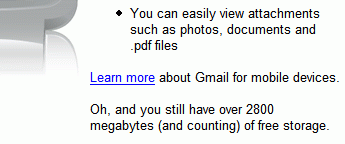
Gmail used to give more free storage every day
Few things grab the eye like a better product, for free. It’s unheard of with physical goods, too absurd to imagine. Free ice cream samples, sure, but a free Tesla? Not happening.
Yet in the world of software, free or at least decreasing prices were the norm for years. Business as usual.
“If it’s digital, sooner or later it’s going to be free” ~ Wired Editor Chris Anderson
One day in 1995, you paid Aol $17/month for email (along with dialup internet—but then, there were few other ways then to get an email address). The next, Hotmail made email free. Then in April 2004, Google gave away free email with 1GB of storage, which compared to Hotmail’s 2MB might as well be unlimited. If that wasn’t enough, for years Gmail added more free storage every day so you’d never run out.
That feeling of getting more for literally nothing peaked with the App Store and early web apps. Where you might have paid hundreds of dollars for boxed software, now the world was filled with apps for $9.99, or $0.99, or even free. Even professional software often had a generous free plan. When Wired editor Chris Anderson wrote “If it’s digital, sooner or later it’s going to be free” in his 2009 book Free: The Future of a Radical Price, it seemed like a new axiom of software pricing.
Then it all came crashing down. $0.99 apps turned into $0.99/month apps; Gmail’s ever-increasing free storage maxed out at 15GB in 2013 and hasn’t gone up since. Your iPhone fills up with photos, and even though iCloud Drive is reasonably priced, it almost feels wrong to pay for tech when we’ve been taught for decades to expect more, for less. Suddenly everything, it seems, wants a subscription.
Yet free is most often a strategy, a means not an end. Apple gives away software to sell devices; Google gives away storage to get you to store more so you’ll upgrade. Free software typically falls into one of three buckets:
- Open-source (free to use, but self-hosted, often with optional paid hosting or support services)
- Freemium (free plans are a loss leader, e.g. Dropbox, with hopes you’ll upgrade, or pay for in-app items in consumer apps)
- The software isn’t the product (e.g. Apple’s software bundled with devices, ad-based social platforms, consumer apps, or simple apps that promote a larger product such as HubSpot CRM to HubSpot’s core marketing app)
Free is a great way to get people in the door. It also can easily make software feel even more expensive when you do need to pay. That—the jump to paying for apps we formerly used for free—perhaps is the thing that makes software pricing top of mind.
Software Inflation: Steeper Than Real-World Inflation
That first leap to paying for software might hurt the wallet—but what’s worse is when you then need to pay more for that same software. It’s like going to the store one day and suddenly realizing everything feels a lot more expensive.
Over the past decade in the US, prices went up around 19% on average. The headline items like rent (+28%), healthcare (+31%) and education (+166%) made life far more expensive, while even small things like milk (+8%) and coffee (+4%) add up. On the other hand, some stuff is far cheaper today. Bananas went down around 5%, home appliances cost 14% less, and televisions are 84% cheaper.
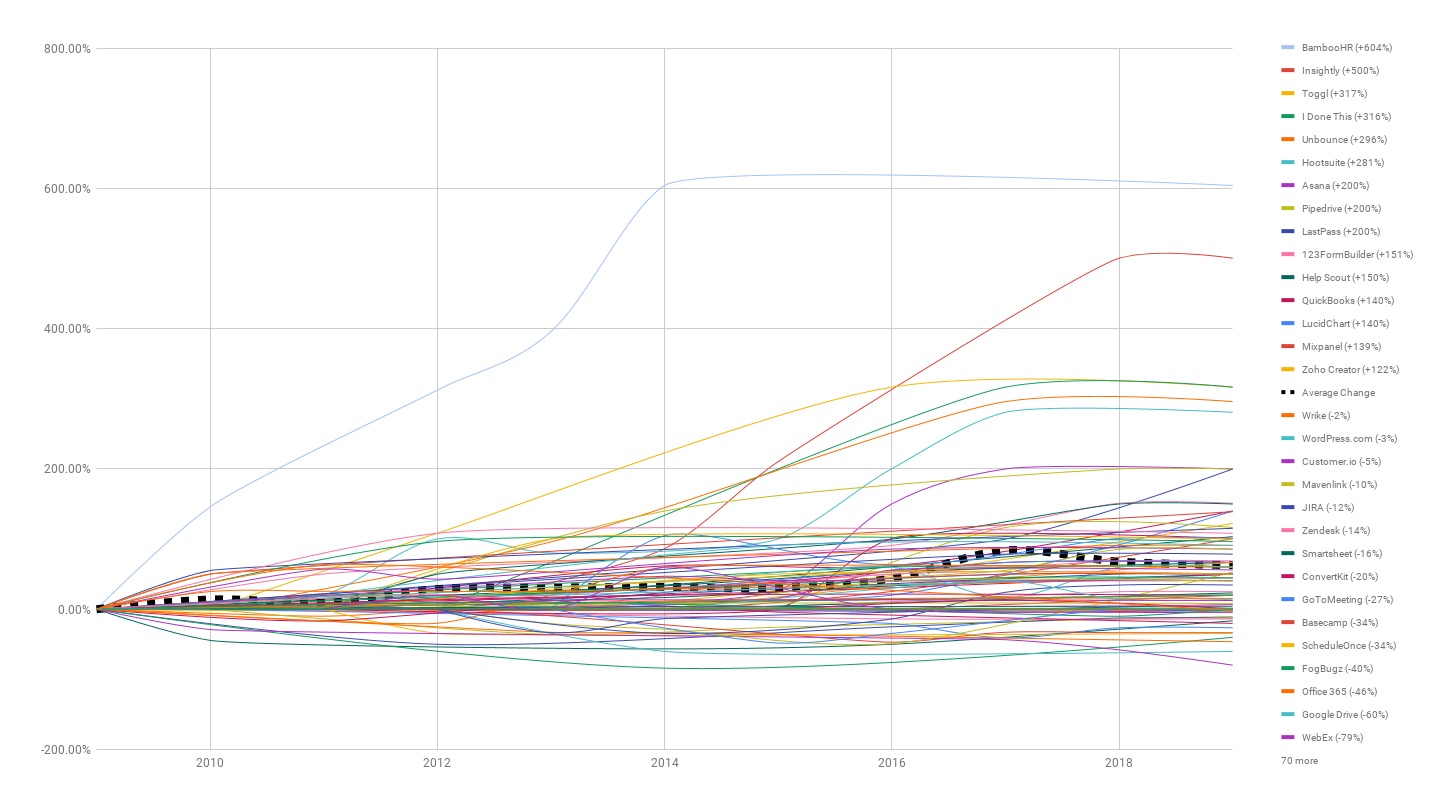
Software prices, on the other hand, went up 62% on average over the past decade—over three times faster than inflation, outpacing even rent and healthcare. Today’s iPhone XR, by comparison, costs 25% more than 2009’s iPhone 3GS (or 67% more if comparing the iPhone XS). Some apps went up far more drastically, though even if you removed the ones whose price went up more than 200%, software still on average went up 42%—or over double the average inflation rate.
Software went up 62% over the past decade—over three times more than the average inflation rate.
If you paid $2.75 for a gallon of milk in 2009, it likely costs $2.99 today—while Best Buy’s best selling 40” TV in 2009 cost $999, while a decade later their best selling 40” TV cost $149 and a 40” 4K TV only $299. But if you paid $9.99 a month for business software in 2009, there’s a good chance you pay $16.18 for it today—if not $19.78.
Of the hundred business apps we surveyed, sixty-seven raised their prices an average of 98% in the decade between 2009 and 2019. Fourteen lowered their prices an average of 28%, and nineteen apps kept their prices the same.
One saving factor is that cheaper apps, on average, went up faster than more expensive apps; apps most commonly went up $5/month. As such, if you bought one account of every app in 2009, you’d pay $4,665 a month. In 2019, you’d pay $6,202, a 33% total increase.
Notably, if the apps you used raised their prices, odds are their prices nearly doubled over the past decade. That’s perhaps even more noticeable than if all of your apps went up a few percent.
It’d be nice if apps always got cheaper and better—and that still happens in some categories such as video calls. A GoToMeeting plan that let 15 people attend your calls in 2010 is 26% cheaper today and lets 150 people join in. That, unfortunately, is the exception.
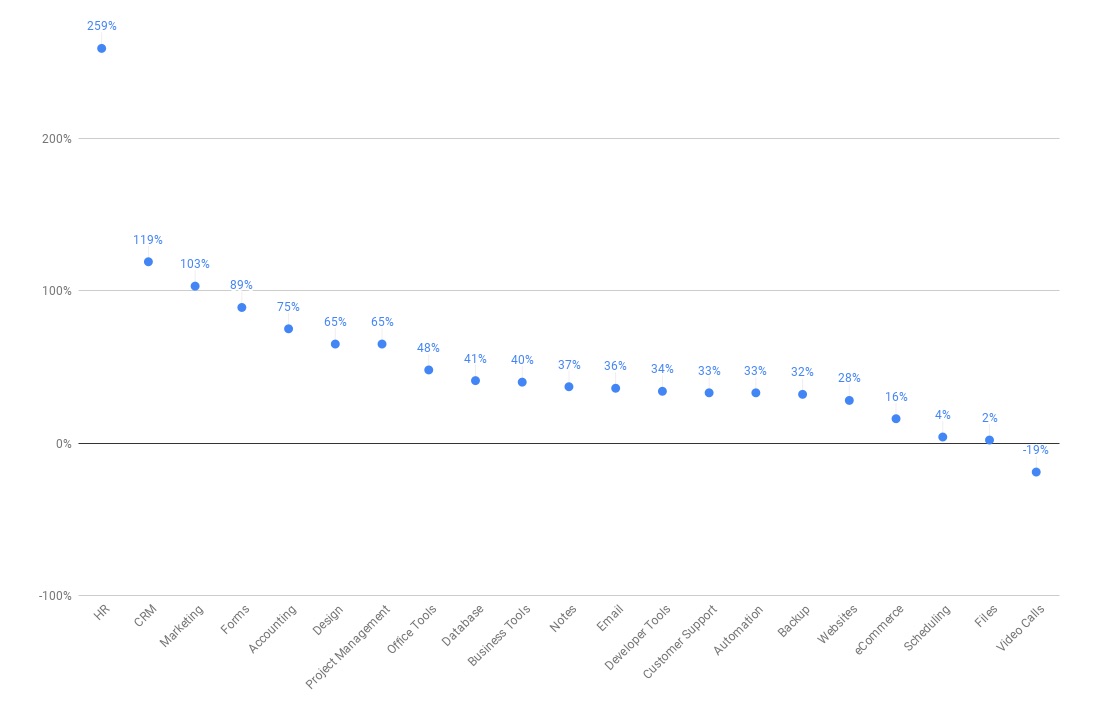
A few categories of software got expensive far faster than others. HR (+259%), CRM (+119%), and marketing apps (+103%) went up the most, while video calls (-19%), file sync (+2%), and scheduling apps (+4%) went down or up only slightly.
Price increases seem to come every few years. 2014 saw the most changes when 19 of the 100 surveyed apps raised prices and 7 lowered them, only to be beaten by 2016 when 20 of the 100 surveyed apps raised their prices and 8 lowered them. And in 2019 so far, 23 apps have raised prices and 7 have lowered them.
Even the apps that didn’t go up in price often technically are more expensive as the same plan today gives you less. Intercom’s original 250 contact plan, for example, now gives you 200 contacts; Infusionsoft dropped more drastically, going from 10,000 contacts to 2,500 for the same price. It’s the software equivalent of ever-shrinking legroom on commercial airliners.
Changes feel even more drastic if apps first lowered prices, then raised them later, as 17 of the apps did. Today’s price may not be all that much different from where it started a decade ago—but it feels far more expensive if you had a discount in between.
And it’s not like you can quit paying. Where you could purchase Microsoft Office or Photoshop in a box then use it forever, today’s subscriptions require you to pay to keep using them. Subscriptions often work out to cost generally the same as if you’d purchased every upgrade in the past. Microsoft Office cost around $8.76 per month on average (or $12.36 adjusted for inflation), in line with today’s Office 365 plans at $8.25 per month for their base business plan. Adobe Photoshop cost an average of $11.40 per month (or $16.76 adjusted for inflation) over a similar period, where today you can get Photoshop and Lightroom together for $9.99 per month. But, at least back then you didn’t have to upgrade. Today you do, regardless of whether today’s price fits your budget.
But At Least You Get More
Yet at the same time, it’s easy to forget how cheap tech is compared to a few decades ago. Instead of paying $199.95 for VisiCalc, today Google Sheets is free, and all of Microsoft Office costs only $5.99 a month. Where 20 years ago it was nearly impossible to store files online without having a dedicated server, and a decade ago Dropbox cost 25¢ per month per GB, today your average GB of online storage costs 0.6-2¢.
That’s not to say software pricing is transparent, that you get the best value for software today, or that you shouldn’t feel anxious over adding another $9.99/month subscription to your growing monthly bills. It’s not, it depends, and you should.
You get more, though perhaps wish you could pay less and get only what you need.
What is true, though, is that when Dropbox goes from $9.99 a month to $11.99, it’s not quite as crazy as it seems. In that case, the price increase came with 40 times as much storage. Even apps that offer generally the same plans today typically have more features and work better after a decade of refinements. GitHub and Basecamp both cost more today, for instance, but you get unlimited repos and projects, respectively.
But then, it’s like a cable bundle: You get more, though perhaps wish you could pay less and get only what you need.
The Case of the Ever Growing Software Bills
At the end of the day, the price at the bottom of the invoice is what we notice. And if that seems higher, you’re not alone. Software really has gotten far more expensive on average over the past decade.
Maybe early apps were under-priced. Perhaps software became more expensive to produce. Or software has gotten better, enough to justify a higher price today as it increases our productivity proportionally. Either way, in an industry where we were long accustomed to getting more for less—an industry where that still holds for most physical products—software has gone up in price three times faster than inflation. That’s hard to ignore.
Explore the Data in our public Google Sheets spreadsheet.
Our Methodology: We researched similar plans from a hundred popular business apps based on top rankings in popular app directory sites. We then checked how much those apps cost for a single user with the app’s primary feature set in 2009 or the next earliest year where pricing was available on the Wayback Machine, and how much the price changed each year until now. Prices current as of publication.
Originally published on the now-defunct Capiche blog on September 3, 2019.